


By Lauren Hite

Last year, Kendrick Lamar used the Super Bowl stage to center Black identity, memory, and resistance in a way that felt intentional and layered. His performance proved that halftime shows can be more than entertainment. They can be cultural statements.
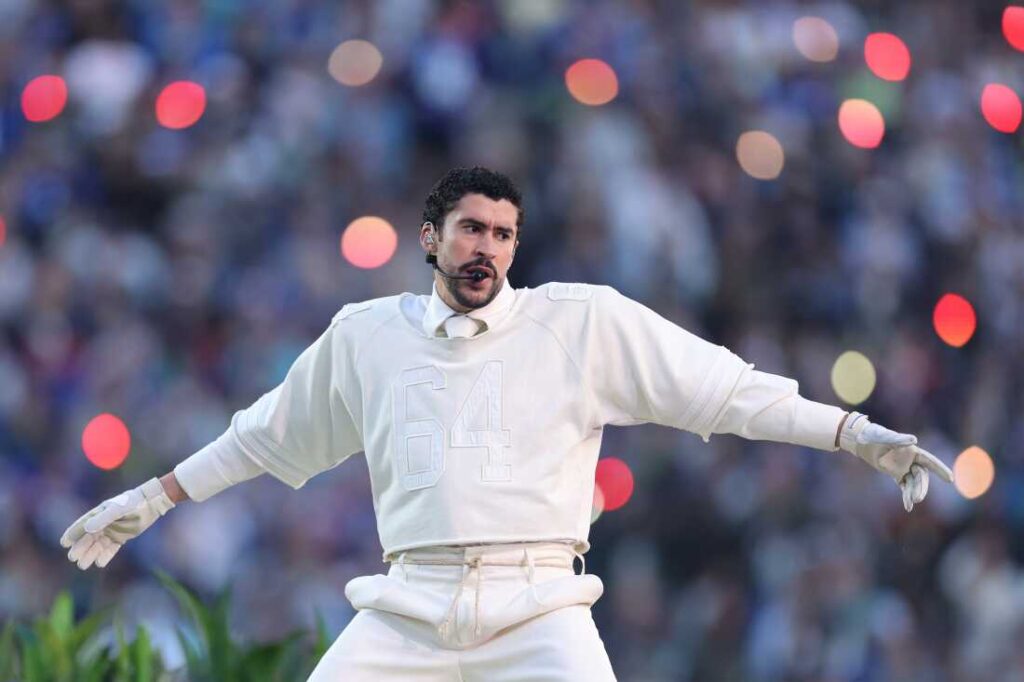
This year, Bad Bunny stepped into that same spotlight and delivered something equally powerful in a different language. And that language difference is exactly the point.
Benito opened with one of his most recognizable Spanish hits, refusing to pivot into English for accessibility. The choice was deliberate. He did not frame his culture as a guest in American space. He presented it as belonging there. The live band incorporated traditional Latin percussion alongside modern production, grounding the performance in Caribbean sound rather than stripping it down for mainstream comfort.
Dancers waved Puerto Rican flags boldly across the field. At one point, the camera focused on a massive projection of the island’s silhouette stretching across the stage. That image carried weight. Puerto Rico remains a U.S. territory whose residents serve in the military but cannot vote in presidential elections. Seeing that flag dominate one of the most American stages in existence was not random. It was pride. It was reminder. It was assertion.
Then came one of the most powerful moments of the night. Benito began naming countries across North America, Central America, South America, and the Caribbean. Mexico. Colombia. Dominican Republic. Brazil. Puerto Rico. One by one. And after naming them, he made it clear: together, we are América.
Not just the United States. América.
That distinction matters. In much of the world, América refers to the entire hemisphere, not one nation. By reclaiming that word on the Super Bowl stage, he challenged a narrow definition of belonging. He reminded viewers that America is not a single identity or a single language. It is a continent. It is migration. It is Indigenous roots, African diaspora, colonization, resistance, and survival woven together.
That message resonates deeply with Black audiences. Historically, Black and brown communities have navigated parallel struggles involving language, labor exploitation, policing, displacement, and cultural erasure. Our music intersects. Reggaeton traces back to Jamaican dancehall and reggae en español in Panama. Afro Puerto Rican musical traditions are inseparable from African history. Our communities have long been connected through sound, movement, and shared resistance.
When Bad Bunny declared that together we are América, it echoed a truth many communities already understand. Liberation is collective. Visibility for one marginalized group expands space for others.
There was also a stadium wide call and response delivered entirely in Spanish. Millions watched without translation. And instead of softening it, he let it stand. He did not explain himself. He did not adjust for comfort. He allowed Spanish to occupy space unapologetically.
For some English speaking viewers, that created distance. But representation is not about universal ease. It is about authentic presence. Black audiences know what it feels like to watch art that was not designed with us centered and still find meaning. Solidarity requires that same openness in return.
The performance was celebratory and vibrant, but it was also layered. Pride in Puerto Rico. Pride in Latin identity. A redefinition of what America means. A reminder that language does not determine legitimacy.
Bad Bunny did not shrink himself to fit the stage. He expanded the stage to fit him.
And when he said together we are América, he made it clear that the story of this country, and this hemisphere, belongs to all of us.